
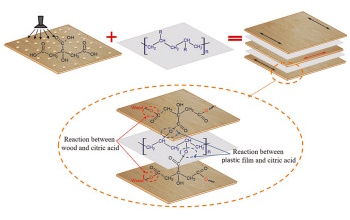
There is a study done by Ukrainian National Forestry University saying that the treatment of veneer surface can increase bonding and properties of the plywood.
This finding is particularly useful for making formaldehyde-free plywood which is weak in bonding due to the use of thermoplastic polymers as bonding material.
The plywood usually use phenol-formaldehyde and urea-formaldehyde as glue. The plywood will constantly release formaldehyde in the room and cause health problems for the people living in the house.
This is why there are many organizations researching using thermoplastic polymers to manufacture plywood.
Low glue adhesion in low formaldehyde plywood
Plywood made with thermoplastic polymers has almost zero formaldehyde (super E0). This is much lower than the ordinary plywood made with urea-formaldehyde.
However, wood veneers are naturally water-absorbing, and thermoplastic polymers are water-repelling. This makes it difficult to achieve good bonding for the low-formaldehyde plywood.
Ways to Increase Veneer Adhesion
There are physical, chemical and mechanical ways to increase thermoplastic polymer adhesions to wood.
- Surface Treatment with modifiers.
- Silane surface modification.
- Interface modifier.
Citric Acid as Modifying Agent
In recent years, scientists have found citric acid helpful in improving properties of wood based panels including plywood, LVL, MDF, and OSB board.
Citric acid is an environment friendly compound. Its interaction with veneers causes cross-links between the functional groups of cellulose and hemicelluloses of timber.
The Ukarine team is the pioneer in doing research on citric acid on plywood production.
Samples in the research:
- Rotary-cut birch veneer 300 × 300 × 1.6 mm
- Citric acid
- PE Films
Conclusions
The treatment of the birch veneer with citric acid increases the bonding strength of plywood.


